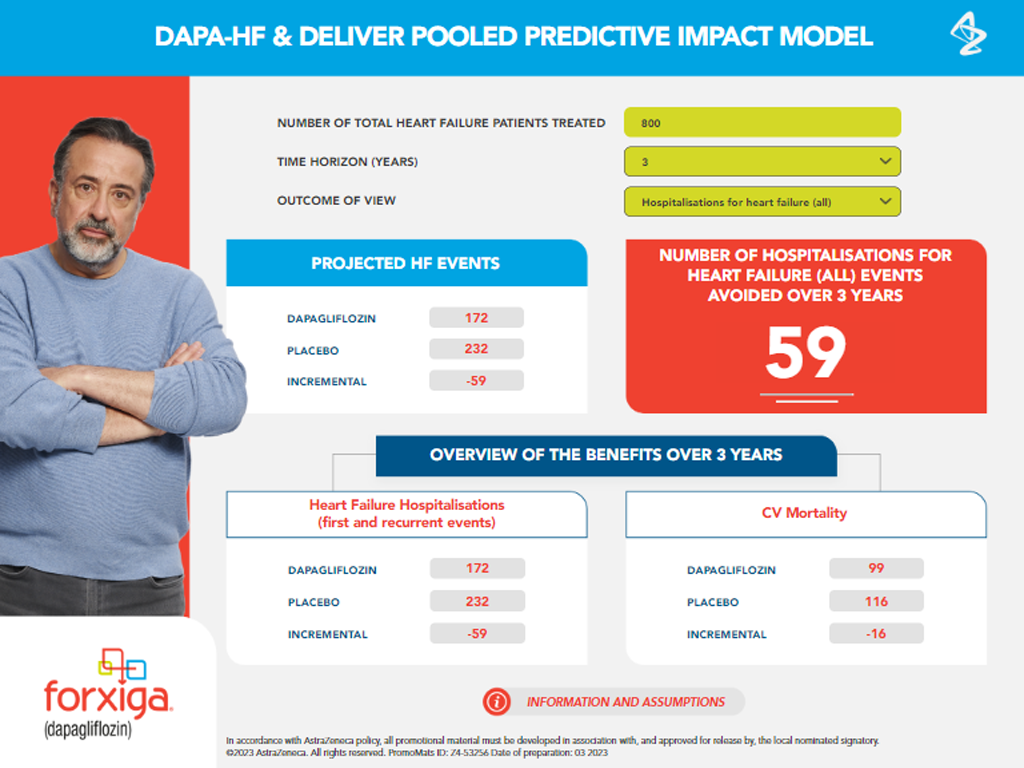
Heart Failure Hospitalisations (first and recurrent events)
CV Mortality
Assumptions:
The objective of the Forxiga Heart Failure Cost-Offset Model
(HF COM) is to communicate the benefit in reducing clinical
events associated with dapagliflozin and with SoC, based on
the results of the DAPA-HF and DELIVER trials.
The model is a cohort-level, partitioned survival model (PSM),
also known as area under the curve modelling, where patients
reside in one of a series of mutually exclusive and jointly
exhaustive health states. In a PSM, establishing time-dependent
health state membership is determined by a series of
independently modelled non-mutually exclusive survival curves.
Exponential survival curves are directly informed using event
rates from the pooled placebo arms of the DAPA-HF and
DELIVER trials. Hazard ratios estimated from the pooled data
are applied to placebo event rates to inform the incidence of
events of dapagliflozin.
The model estimates outcomes over a time horizon of 3 years.
Limitations:
A fundamental structural limitation of a PSM is that the
survival curves for each health state are independent.
However, for within-trial modelling these dependencies are
inherently captured within the observed data from the trial.
The model provides an estimate of the baseline event rates
in the placebo arm based solely on observed trial data.
The application of hazard ratios to baseline placebo event
rates is independent of any assessment of the validity of the
proportional hazards assumption.